
The Lime Swap: Why Retention Budget Cuts Quietly Break Programs That Work

Chocolate. Pemmican. Sugar. Biscuits. Butter. Tea.
That was the daily ration Robert Falcon Scott's men carried toward the South Pole in 1911. Herbert Ponting, the expedition photographer, took a picture of it. The meat had been inspected carefully for spoilage. There was no fruit.
None of the five men who reached the pole came home. Scurvy is thought to have played a part.
By then, the British navy had known how to prevent scurvy for more than a century. It had the cure, it had used it at scale, and it had beaten the disease. Then it improved the cure on the wrong theory until the cure stopped working, and the experts blamed the meat.
I call this the lime swap. It happens when a team changes a program that works, based on a wrong theory of why it works. The visible ingredient stays. The real one gets cut. Because the decline is slow, the cause gets pinned on something else.
It's October, and retention budget cuts for 2027 are being decided right now. Most of them are lime swaps waiting to happen.
A cure that worked, then got cheaper
Judea Pearl tells this story in The Book of Why, as an example of what happens when you know that something works but not why.

In 1747, a Scottish naval surgeon named James Lind ran one of the first controlled experiments on record. Citrus fruit prevented scurvy, a disease estimated to have killed 2 million sailors between 1500 and 1800. By the early 1800s the British navy had all but beaten it. Every ship sailed with citrus.
Nobody knew why citrus worked. The accepted theory was acidity. Citrus is sour, and sourness fights scurvy. Under that theory, any acid would do.
So the navy did what any operator does with a working program and a cost problem. It switched from Spanish lemons to cheaper West Indian limes, which were just as acidic. Then it started boiling the juice to purify it.
Limes carry about a quarter of the vitamin C that lemons do. Boiling likely broke down much of what was left. Each change protected the acidity, which was the theory. And each one cut the vitamin C, which was the mechanism.
Scurvy came back. The British Arctic expedition of 1875 suffered from it while drinking lime juice. The medical establishment went looking for a cause and found one in the data: sailors who ate fresh meat stayed healthy, and sailors who ate tinned meat got sick. Scurvy, they concluded, came from tainted food. By 1903, the physician on Scott's first Antarctic expedition was calling the benefit of so-called antiscorbutics "a delusion."
That's how a ration list with no fruit on it reached the South Pole.
The real mechanism wasn't known until the 1930s, when Albert Szent-Györgyi isolated vitamin C. That's Pearl's point. If you can't explain a cause, you can't protect it, and the first cost cut can take it out.
Every working program has an unwritten theory
Nobody writes down why a flow works. They write down that it works: revenue per recipient, attributed revenue, conversion rate. The theory lives in people's heads, and it's usually the most visible feature of the program.
The welcome offer works because of the discount. The post-purchase series works because it's four touches. SMS works because SMS gets opened.
Those are acidity theories. They describe what's easy to see. Sometimes that's what does the work, and sometimes it's the lime.
The theory gets tested the day someone needs the program to be cheaper. A cost cut is a bet on it. You keep what you think matters and remove what you think doesn't. If the theory is right, you save money. If it's wrong, you've kept the acid and boiled out the vitamin C, and the dashboard won't say so for months.
What the discount data showed
I've watched this play out with welcome offers.
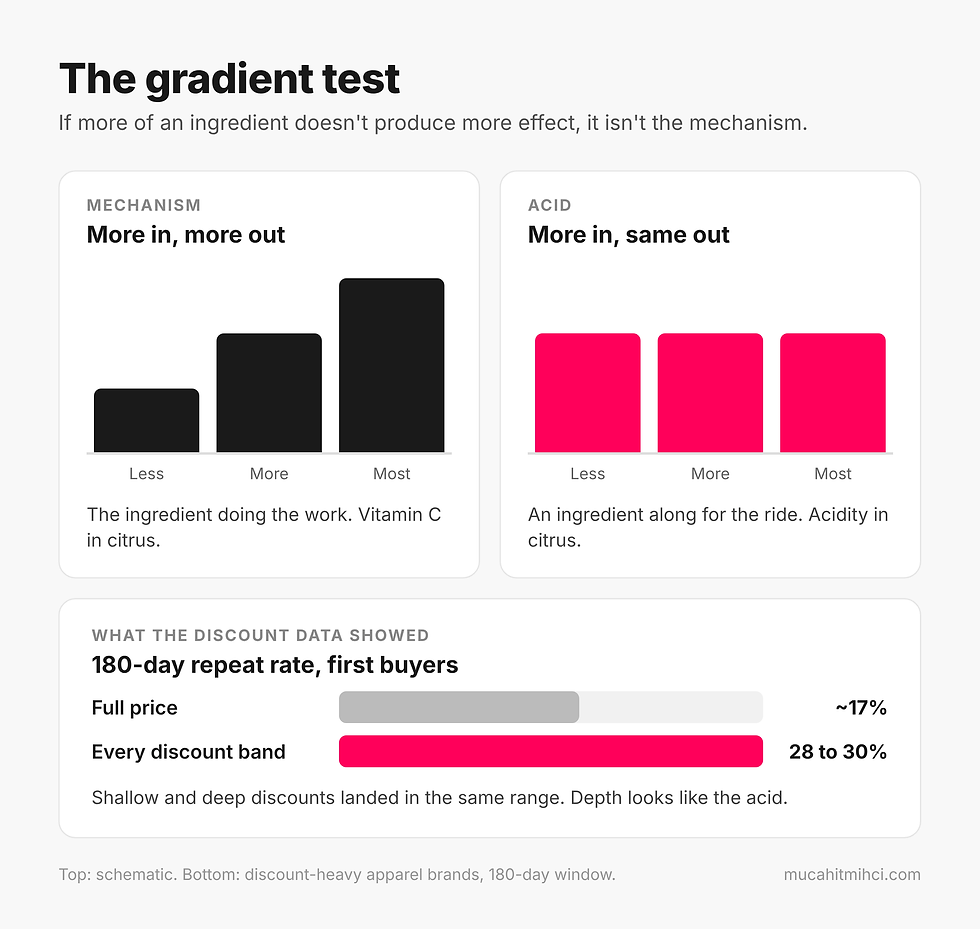
Across discount-heavy apparel brands I've worked with, first buyers who used a discount repeated within 180 days at roughly 28 to 30%. Full-price first buyers repeated at roughly 17%. That runs against the published consensus, and I wrote it up in Discount Customers Have Lower Lifetime Value. Ours Didn't.
What didn't show up mattered more. There was no gradient by discount depth. Shallow and deep discounts landed in the same range. If the discount itself drove repeat purchase, deeper discounts should have produced more of it.
Pearl would call that a missing dose-response. When more of an ingredient doesn't produce more of the effect, that ingredient probably isn't the mechanism. Discount depth looks like the acidity.
The variable that did separate customers was the way they came in. Customers acquired through owned email and SMS repeated at about 30%. Customers from paid search and shopping repeated at about 18%.
So the leading suspect for the vitamin C is the signup. The discount gets someone into a channel the brand can talk to for free, and the second order comes from that channel.
At this stage it's a suspect. Customers who give you their email might simply be different people from customers who don't, and that difference alone could produce the gap. Calling it proven would be the navy's mistake all over again: reading a mechanism off a pattern because the story fits. The only way to know is a test.
What the data does settle is the cost of guessing wrong. Picture the most common welcome-offer cut. Paid social already runs a sitewide code, so the team moves the offer out of the popup and into the ad. Same discount, no signup, one less form.
If the signup is the vitamin C, that move keeps the full margin cost and drops the part that produced the repeat rate. Deepening the discount to push repeat purchase is the same mistake from the other side. More acid, no extra vitamin C.
Why lime swaps stay hidden

The damage is lagged. A program that drives second purchases shows its damage over a 60 to 180 day repeat window. A cost cut shows its savings the same month. The savings land in one quarterly review and the damage lands in another.
The metric being watched isn't the one that breaks. Most flow reports judge a program on revenue inside an attribution window. A welcome offer moved into an ad still converts first orders, so first-order revenue looks fine. Repeat rate, the number that actually fell, lives in a cohort report nobody pulls in the same meeting.
A tainted-meat explanation is always available. CPMs rose. The list aged. The spring collection was weak. Each one is plausible and each one fits part of the data. The navy's experts had a pattern and a story too.
How to find the vitamin C before you cut
Retention costs can come down. The cut just has to start as a test of your theory before it becomes policy.
Write the arrow. For each of your five highest-revenue programs, write one line: this program works because of this. The welcome offer works because it gets customers into email and SMS. The post-purchase series works because the second message lands when the first product runs low. If the team can't agree on the line, nobody knows the mechanism, and the program is exposed to the first cost cut that comes along.
Look for the gradient. If you believe a feature drives the result, check whether more of it produces more result. Deeper discounts, more sends, more SMS. If the effect is flat across levels, that feature is the acid.
Test the cheap version against the current one. Before a cut ships to everyone, run it against a holdout that keeps today's program. Judge it on the metric the program exists to move, over the window that metric needs. For anything aimed at a second purchase, that's repeat rate at 90 days minimum and 180 days if you can wait. A 7-day revenue read will approve almost every lime swap.
Give the mechanism an owner. Programs have owners. Mechanisms usually don't. Someone should be able to answer "why does this work?" before anyone gets to answer "how do we make it cheaper?"
Monday morning diagnostic
Pull 180-day repeat rate for first buyers by discount depth band. If the shallowest and deepest bands sit within 3 points of each other, depth isn't driving repeat purchase. Every extra point of discount above your shallowest band is margin spent on acid.
Pull the same repeat rate by acquisition source, owned versus paid. If owned-channel customers repeat at 1.5 times the paid rate or more, treat the signup as your lead suspect. Any change that lets customers skip it, including moving offers into ads, gets a holdout before it ships.
List every retention cost cut from the last 12 months. For each one, write down the metric and the window it was judged on. If the answer is attributed revenue over 7 or 30 days, pull cohort repeat rate for the six months after the change. That's where a lime swap shows up.
For every cut in the 2027 plan, write the arrow first. If nobody can say why the program works, test it before you cut it.
The navy kept its citrus for a century and still lost the cure, one sensible saving at a time. Budget season is when retention programs get their limes.
If you want a second pair of eyes on the 2027 cut list before it ships, here's how I work with brands.
Frequently Asked Questions
What is a lime swap in retention marketing?
A lime swap is a change to a working retention program that keeps the feature the team believes drives results and removes the one that actually does. The term comes from the British navy replacing lemons with cheaper limes to prevent scurvy, keeping the acidity they credited and losing most of the vitamin C that did the work.
How do I know which part of a flow is actually driving results?
Start with the gradient. If more of a feature, like a deeper discount or more sends, doesn't produce more of the result, that feature probably isn't the mechanism. Then run any change against a holdout that keeps the current version, and judge it on the metric the program exists to move.
Why don't retention budget cuts show up in revenue right away?
Most retention programs drive second purchases, which show up over 60 to 180 days. Cost savings show up immediately. Flow reports usually judge programs on attributed revenue in a short window, so the damage appears later in cohort repeat rate, where it's easy to blame on something else.
Does a bigger discount improve repeat purchase rate?
In the discount-heavy apparel brands I've worked with, it didn't. Discounted first buyers repeated at a higher rate than full-price buyers, but shallow and deep discounts performed about the same. The stronger signal was whether the customer came in through an owned channel like email or SMS.


Comments