

Lapsed Customer Reactivation: Your “Owned” Customers Don’t Belong to You

Your returning customer rate is declining. It's been declining for three quarters. And every time your team presents lifecycle metrics, they show you open rates and flow revenue that look fine.
But you're watching the P&L, and returning customer revenue as a percentage of total revenue keeps shrinking. Nobody in the room can explain why.
I can.
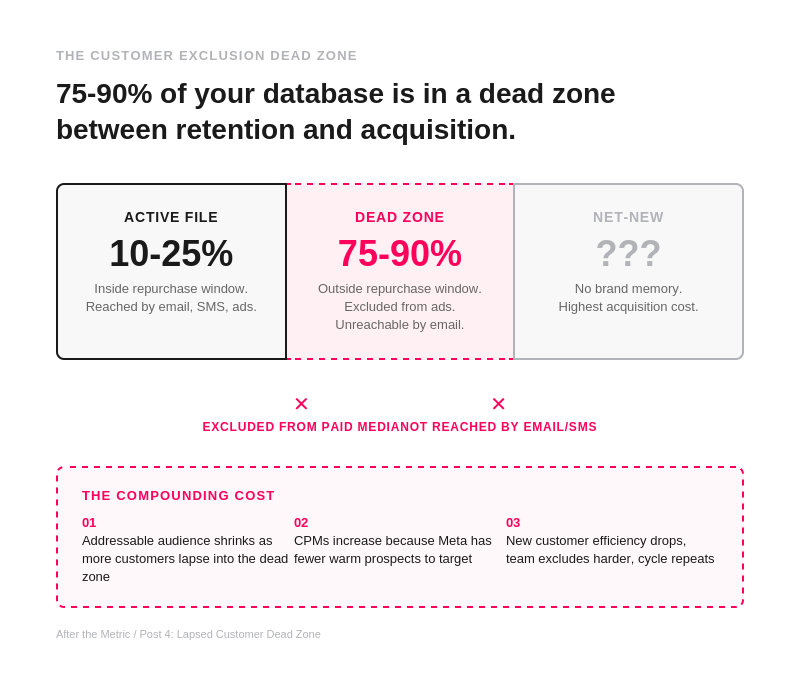
Go pull your full customer database right now. Filter for everyone whose last purchase was more than 6 months ago. For most apparel brands doing $5M+, that number lands somewhere between 75% and 90% of the entire file.
Three out of four people you've paid to acquire are functionally strangers again. And your team is hard-excluding every single one of them from your ad campaigns.
The "Owned Audience" Fantasy
There's this belief in ecommerce that once someone buys, they enter a permanent state of being "your customer." They're on the email list. They're on SMS. They're owned.
The logic sounds reasonable: why pay to reach them again when I can sell to them through retention channels? Email is free. SMS is cheap.
Except you don't have them.
Someone who bought a pair of shorts from you 14 months ago and hasn't opened an email since last summer is not your customer. They're a lapsed stranger with a faint memory of your brand. Your weekly email blast goes to their promotions tab. Your SMS gets deleted. Your "free" retention channels aren't reaching them.
But because they exist in your database as a "past purchaser," they're being systematically excluded from every ad campaign you run.
You've created what I call a customer exclusion dead zone. Too old to be a returning customer. Too excluded to be re-acquired.
How to Define Who's Actually Active
Stop using "has purchased before" as your definition of a returning customer.
Pull the time between first and second purchase for every repeat buyer in your data. Plot the distribution. You'll see that the vast majority of second purchases happen within a specific window. Maybe 90 days, maybe 150 days, depending on your category and price point.
Find the point where roughly 80% of repeat purchases have already happened. That's your active customer window.
Inside that window? Active. Exclude them from acquisition campaigns if you want.
Outside that window? Lapsed. They're not coming back on their own. And re-acquiring them is almost certainly cheaper than finding a total stranger, because they already know your product, they've already trusted you with their credit card, and they have some memory (however faint) of your brand.
The Silent Tax of Over-Exclusion
Here's what actually happens at most brands doing $5M+ in revenue.
The marketing team tracks something like "new customer ROAS" or an efficiency metric that isolates new customers from returning ones. As the brand accumulates more past purchasers, Meta inevitably shows some ads to those past buyers. The new customer metric starts looking worse. Not because acquisition got less efficient, but because the denominator is polluted.
The response? Exclude harder. Tighten the suppression lists. Push Meta to only find net-new people.
But you've now told Meta to ignore a massive pool of people who are warm, familiar, and likely to convert at a fraction of the cost. Every time you tighten that exclusion, your addressable audience shrinks. CPMs go up. Efficiency drops. You cut spend. Revenue falls across all customer types.
It's a slow-motion suffocation.
And the irony is brutal: the metric you're protecting (new customer efficiency) is actually causing the business to shrink. You're optimizing a dashboard while starving the P&L.
What I Found Inside the Data
I spent three months studying the overlap between lifecycle engagement data and paid media exclusion lists across multiple apparel brands at Trafilea. What showed up was consistent enough to call it a pattern.
At one brand, 82% of the customer database hadn't purchased in 7+ months. Every one of those customers was hard-excluded from paid ads. The lifecycle team was sending them the same weekly promotional email as everyone else (same subject lines, same offers, same product mix). Open rates on that segment had dropped to single digits. They weren't being reached by email. They weren't being reached by ads. They were in a dead zone nobody was tracking.
When we carved out a small test audience of lapsed customers (7-14 months since last purchase) and allowed Meta to reach them, the cost to re-acquire was 38% lower than net-new acquisition. This is what lapsed customer reactivation actually looks like in ecommerce: not an email sequence, but a paid media strategy change. The 60-day LTV on those re-activated customers was 1.4x higher than new customers acquired in the same period. These weren't flukes. People who already knew the brand converted faster, bought more, and returned sooner.
The uncomfortable part? Nobody had tested this before because the team assumed lifecycle was "handling" those customers. The CRM said they were "owned." The data said they were ghosts.
This connects directly to something I've written about before. If your lifecycle platform doesn't know what's in stock, and it doesn't have real customer behavior data connected to it, then of course it can't re-engage lapsed customers. You're relying on a channel that's flying blind to do a job it was never set up for. And then you're excluding those same customers from the one channel (paid media) that could actually reach them.
It's the same root problem from every angle: your lifecycle platform operates in isolation from the data that matters.

Lapsed Customers Might Be Your Cheapest Growth
A net-new customer has never heard of you. They need to be interrupted, educated, convinced, and converted. All from scratch. That's expensive.
A lapsed customer already knows the product. They've used it. Maybe they liked it. Maybe they just forgot about you because life happened, or they found something else, or your emails stopped being interesting. The barrier to re-conversion is dramatically lower.
Not every lapsed customer is worth chasing. Some had bad experiences. Some genuinely moved on. But the math on re-engaging a warm audience vs. ice-cold prospecting almost always favors the warm audience.
The question is whether you're even testing it. Most brands aren't. They've assumed that everyone in the database is handled by email and SMS, and they've never run an incrementality test to see what happens when Meta is allowed to reach those lapsed buyers.
The Monday Morning Diagnostic

Here's what to bring to your next marketing meeting.
Ask your growth team two questions. First: what percentage of our customer database is currently excluded from paid campaigns? Second: what's the actual repurchase window, meaning the point where 80% of repeat purchases have already happened?
If the exclusion window is significantly wider than the repurchase window, you have a dead zone. You're blocking Meta from reaching people that your retention channels can't reach either.
Then ask a harder question: has anyone ever tested what happens when we let paid media reach lapsed customers? If the answer is no, you've been making one of the most expensive assumptions in your media strategy without any data behind it.
Redefine your "existing customer" exclusion to only include active customers (inside the repurchase window). Let lapsed customers back into the addressable audience. Then run a holdout test, a small geo or audience carve-out, and measure the incremental return. Not platform-reported return. Actual net revenue lift.
Compare the cost of re-acquiring lapsed customers against net-new acquisition. If the pattern I've seen holds, the difference will be significant enough to change how you allocate spend next quarter.
FAQ
How do I calculate my active customer window for lapsed customer reactivation? Pull the time between first and second purchase for every repeat buyer in your database. Find the 80th percentile. That's your active customer window. Anyone who last purchased beyond that window is lapsed and should be treated differently than an active returning customer, both in lifecycle communications and in paid media suppression lists.
Should I treat all lapsed customers the same in paid media campaigns? No. There's a meaningful difference between someone who lapsed 6 months ago and someone who lapsed 2 years ago. The 6-month lapsed customer still has brand recall and is significantly cheaper to re-acquire through paid media. Start your testing there. As you get incrementality data, you can expand or narrow the repurchase window based on what's actually converting.
Won't allowing lapsed customers into my ad campaigns inflate my returning customer numbers and make new customer metrics look worse? Only if you're measuring wrong. Segment your reporting so that "returning customer revenue" is broken into active returns and lapsed re-acquisitions. A lapsed re-acquisition is closer to a new customer in terms of effort and cost, and conflating the two is exactly the measurement mistake that created the customer exclusion dead zone in the first place.
One question for you: What percentage of your customer database is actually lapsed? Run the numbers. I bet it's higher than you expect.


Comments