

LTV Drift

Updated: Aug 31
Your quarterly review just approved next quarter's acquisition budget. The LTV number looked fine. It always looks fine.
What nobody checked is whether the customers you acquired in the last six months are performing anywhere close to the customers who built that LTV number. They're probably not. And by the time the gap shows up in the aggregate, you've already set spend, committed to targets, and told the board you're on track.
I call this LTV Drift. By the end of this post you'll know how to find it in your own data, which lifecycle decision caused it, and what to bring into the next budget conversation that your team can't argue around. That's the difference between managing LTV and being managed by it.
Why your ecommerce LTV aggregate is hiding the real number
Your aggregate LTV is a weighted average of every cohort you've ever acquired. The customers from 18 months ago who've bought four times are in that number. So are the customers from last quarter who've only bought once. When acquisition volume grows, the strong historical cohorts hold the average up while your recent cohorts quietly underperform.
The signal you actually need is 60-Day LTV tracked by cohort month. Not a single number. A trend line across the last 12 months of acquisition cohorts. In every brand I've worked with where drift was happening, that trend line told a completely different story than the aggregate.
The same window problem sits one metric upstream, in repeat purchase rate by cohort. If that one is blended, your LTV cohorts inherit the distortion before you start.
Here's what the divergence typically looks like. Cohorts from 14-18 months ago hitting second-purchase rates of 38-42%. Cohorts from the last six months sitting at 24-28%. The aggregate doesn't show it because the older cohorts are still pulling the average. But those recent cohorts are your customer base in 12 months. And your acquisition budget for next quarter is being calibrated against a number that still includes customers who no longer represent what you're actually buying.

Everyone agreed the market had changed. Nobody checked the cohorts.
Here's the scene. Quarterly review. Someone pulls up the LTV dashboard. The number is flat, maybe up slightly. Someone says acquisition costs are rising but retention is holding. The budget gets approved. Nobody asks which cohorts are holding.
I've been in versions of that room more times than I can count. And the thing that's almost never on the table is a cohort-level trend line. Not because nobody could build it. Because nobody owns the question. Acquisition owns CAC. Lifecycle owns flow performance. Nobody owns the connection between a lifecycle decision made in October and what it did to the November cohort.
That ownership gap is where drift lives. Not in the data. In the accountability structure. And it compounds every quarter you don't name it.
You didn't overspend. You spent against the wrong number.
If your FOV:NCAC is running at 1.2, which is thin but common in apparel, your business model depends on 60-Day LTV doing the work. The first order barely covers acquisition. The second and third orders are where the margin is. If recent cohorts are converting to a second purchase at 24% instead of 38%, you're not watching a retention metric soften. You're buying customers at a unit economics profile that doesn't support your current spend.
The timing is what makes it structural. Acquisition budgets get set 4-6 weeks before the quarter opens. The LTV number informing that budget reflects historical cohorts that performed well. The recent cohorts that will actually determine this quarter's profitability haven't matured yet. So you commit spend at one margin assumption and realize the result at a different one.
That delta is EBITDA. Not theoretical future EBITDA. This quarter's EBITDA, already locked in by a budget decision made against stale data.
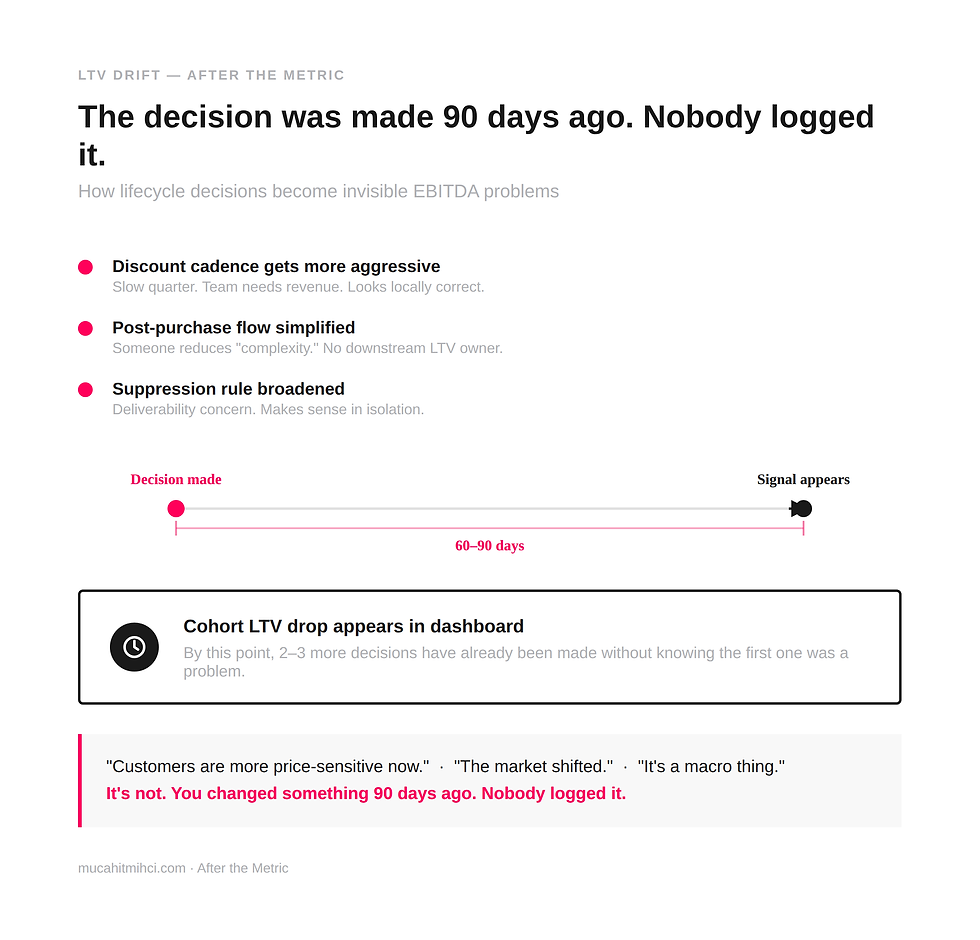
The decision was made 90 days ago. Nobody logged it.
The drift doesn't start with a bad campaign. It starts with a decision that made sense at the time.
A discount cadence that got more aggressive during a slow quarter. A post-purchase flow that someone simplified to reduce "complexity." A suppression rule that got broadened to protect deliverability. Each one looked locally correct. None of them had a downstream LTV owner.
The consistent pattern: the gap between when the causal decision was made and when it appears in cohort LTV is 60-90 days. By the time it's visible, you're three decisions removed from the cause. And because nobody logged the decision against the cohort, the conversation defaults to "customers are more price-sensitive now" or "the market shifted."
It didn't. You changed something. And you can find it if you know where to look.
What to do Monday morning
Pull your 60-Day LTV by cohort month for the last 12 months. Not the average. The monthly line. If the last 4-6 cohort months are running below the prior 6, drift is already in the business.
Then ask your lifecycle team one question: what changed in the 60-90 days before those cohorts dropped? Not which campaign underperformed. Which decision got made. A flow edit, a suppression change, a discount policy shift, a product mix change in what you were promoting to new buyers. Something changed. Find it before you walk into the next budget meeting and approve acquisition spend against an LTV number that's still catching up to what your recent cohorts are actually worth.
The brands that catch this early share one structural thing: someone is accountable for cohort LTV by month of acquisition, not just aggregate LTV by quarter. That's a leadership decision, not an analytics one. Make it before the next quarterly review does it for you.

FAQ
What is LTV Drift in ecommerce?
LTV Drift is the gap between a stable aggregate lifetime value number and a deteriorating cohort LTV trend. The aggregate holds because it averages strong historical cohorts against weaker recent ones. The business impact is that acquisition budgets get set against historical ecommerce LTV while recent cohorts, which will determine actual profitability, are underperforming. The result is EBITDA erosion locked in before anyone saw it coming.
How do you measure cohort LTV ecommerce brands should track?
Group customers by the month of their first purchase. Track 60-Day LTV for each cohort month and plot it as a trend line across the last 12 months. Compare the last 4-6 cohort months against the prior 6-month average. A declining trend across consecutive cohorts is LTV Drift. A single bad cohort is noise. The distinction matters because the cause and the response are completely different.
What lifecycle decisions cause ecommerce LTV to decline across cohorts?
The most common causes are decisions made 60-90 days before the drop appears in data: more aggressive discount cadence, simplified post-purchase flows, broadened suppression rules, or a shift in which products get promoted to new buyers. None produce an immediate LTV signal so they don't get reversed. The fix isn't finding the right campaign. It's identifying which decision changed the cohort's trajectory and who owns that accountability going forward.


Comments