
Involuntary Churn Is the Clock Nobody Owns

Your monthly churn review is on the calendar for Thursday. The retention lead has the cancel-reason breakdown ready. Growth wants to test a deeper save offer. Someone from finance asks whether the pause option is quietly cannibalizing revenue.
Forty minutes later the room has an action list: new cancel flow copy, a skip-a-month test, a win-back offer for everyone who left citing price.
Nobody opened the payment decline log.
I've sat in that meeting at more than one subscription brand. The churn number on the slide is two numbers added together, and the discussion only addresses one of them.
One number, two clocks
I call this two-clock churn. Subscription churn runs on two separate clocks. One counts voluntary cancels. The other counts involuntary churn: customers the system cancelled after their payment failed. Different causes, different owners, different fixes. Report them as one rate and you can't tell which clock is running fast.
Clock one: failed payments
Clock one runs on expired cards, insufficient funds, a bank flagging the charge, a card reissued after fraud. The customer still wants the product, and often doesn't know anything went wrong until the box doesn't arrive.
These customers never see your cancel flow or the exit survey, so the cancel-reason dashboard debated on Thursday only describes people who chose to leave.
And the ownership is a mess. The payment processor and the billing settings sit with ops or finance. The churn metric sits with marketing. The retry schedule was set by whoever installed the subscription app, and nobody has touched it since. That's automation debt: a day-one rule running unsupervised on a customer base it was never built for.
Ask "who owns failed payments here?" and at most brands you get a shrug that lands halfway between two departments. It's the same shape as the lifecycle accountability gap. Everyone can see the number. Nobody answers for it.
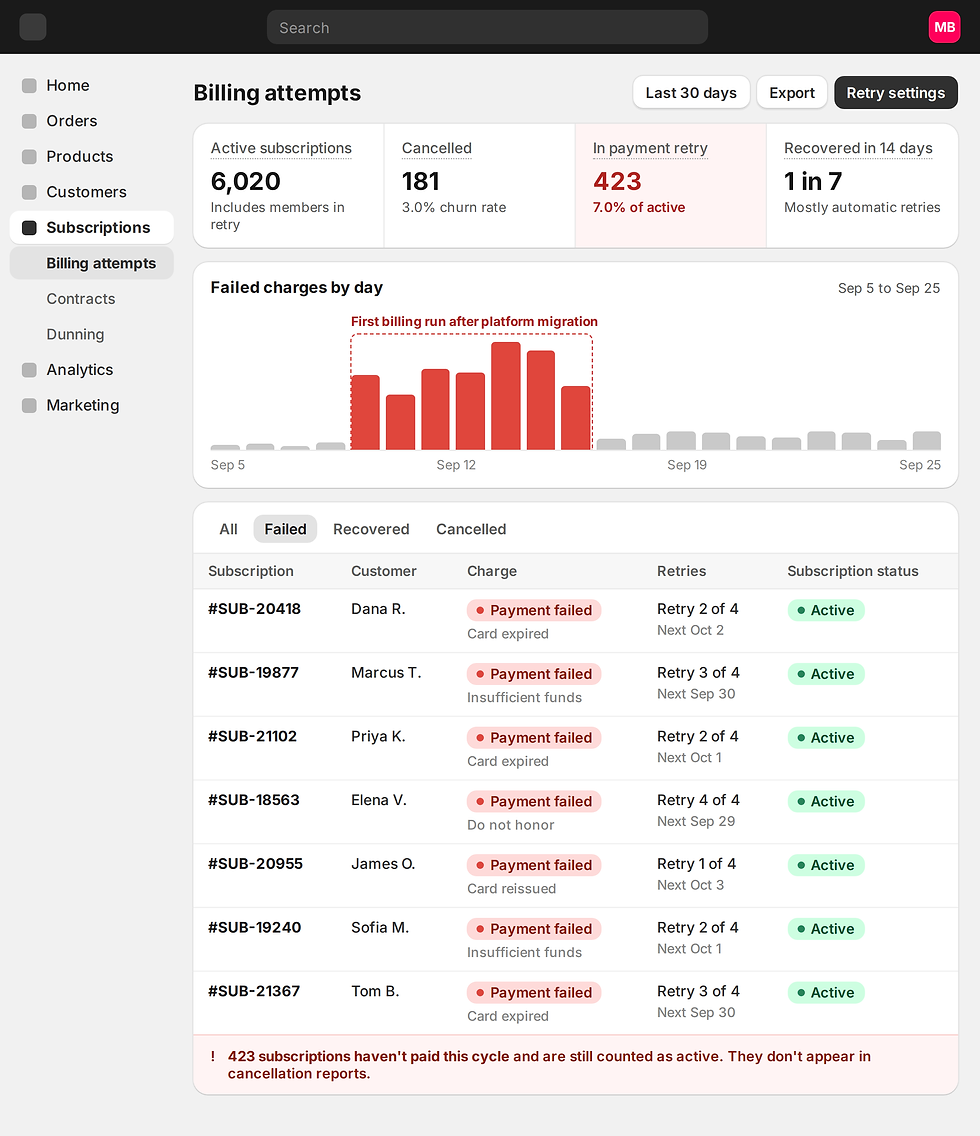
Here's what that looked like last month at a membership brand I work with. The cancel line on the report was unremarkable: around 3% for the month. Behind it, more than twice as many members were sitting in failed payments as had cancelled. Every one of them was still counted as active. That was roughly 7% of the "active" base, and roughly 7% of the month's billing, not collected. The report had no line for it.
Most of those failures landed in one week: the first billing run after the brand moved to a new subscription platform. The likely cause was the move itself, carrying over cards that were already failing on the old one. For that week, about a third of charges failed. After it, fewer than one in ten. A platform switch is a clock-one event, and nobody plans it as one.

Clock two: cancellations
Clock two is voluntary. The value didn't land, product piled up, the cadence was wrong, or the price stopped feeling fair. This is where cancel flows, skips, swaps and pauses belong, because there's a decision to influence.
It's also the expensive clock. Almost every save carries a cost: a discount that reprices every future order, a free add-on, a pause that pushes revenue into a later quarter. All of it comes out of contribution margin.
Why blending them breaks decisions
A pause offer can't fix a declined card. A retry schedule can't fix a customer with three unopened boxes in the hallway.
When both clocks share one number, every intervention gets judged against movement it was never designed to cause. Ship a better cancel flow in the same month a batch of cards expires, and churn goes up. The test reads as a failure. Maybe it gets rolled back.
The expensive version: leadership decides the product has a value problem and funds a richer save offer. The brand discounts customers who were never going to leave, while the cheaper clock runs untouched.

Why failed payments are the cheaper clock
Failed payment recovery doesn't require convincing anyone. The customer already said yes. You're only helping the charge go through.
A recovered order comes back at full price, with no future order repriced. Order for order, a recovery on clock one is worth more to the P&L than a save on clock two. Whether that customer stays as long as one who never failed is a separate question. Check it in your cohorts before promising anyone a lifetime number.
The tooling isn't free. Recovery apps charge a platform fee or a share of what they recover, and SMS costs grow with the list. But that's a fee on revenue that came back, not a discount on every future order.
And every lever on this clock can be rolled back in a day. Clock-two saves can't. Once a discount has repriced a customer, that customer has learned the price.
This clock also runs whether anyone's watching, and the calendar is about to get worse. Every subscriber you acquire over Black Friday hits a first renewal in late December or January, the stretch when card balances are at their tightest of the year. A new subscriber has no habit of updating a card with you and little reason to chase a failed charge. If clock one has no owner by then, a share of your holiday acquisition budget cancels itself before the second box ships.
Five decisions sit on this clock, and none needs a new vendor.
Does the retry schedule know why a payment failed? Insufficient-funds declines often clear a few days later, around pay cycles. Hard declines rarely clear, and retrying them repeatedly can draw fees from the card networks.
Is card updater on? Visa and Mastercard pass reissued card details to merchants. Some processors apply it automatically, others need it enabled, and plenty of teams have never asked.
Do we warn before a card expires? You know the expiry date of every card on file. A short email and SMS a couple of weeks before it lapses, with a one-tap update link, prevents the failure instead of chasing it afterwards. Then check who can receive it. If the reminder is set up as a marketing message, everyone who unsubscribed from promotions never sees it, even though they're still paying you. At the brand above, that was about one paying member in seven.
How many steps sit between our dunning message and the card field? Most brands send one email that explains the problem and links to an account login. The version that recovers is short, repeated over a week, sent on more than one channel, and opens straight to the card update screen. Tone matters less than you'd expect. Friction matters more.
How long does a failed subscription stay alive? Cancel on the first failure and you've turned a fixable billing problem into an acquisition problem you'll pay CAC to solve.
The grace period has a quiet side effect. While a subscription sits in retry, most systems still count it as active. Stretch the window and your active subscriber count looks healthier while a backlog of unpaid accounts grows underneath it. That's exactly how 7% of a base ends up "active" while paying nothing. Report subscriptions in dunning as their own line, or the fix hides the problem it was meant to solve.
None of this works if your stack can't see why a payment failed. If your subscription app doesn't pass decline codes through, that's the first request to make.
The same brand shows how thin the default is. Its only recovery touch was a single payment-issue email. Most failed members received it, plenty opened it, and fewer than 3 in 100 clicked. After two weeks, about one in seven had paid, and most of those came through automatic retries, not the email. Nine in ten failures were card-side, so a warmer tone was never going to move it. What we're shipping instead: three touches over a week, email and SMS, one button that opens the card screen, and a recovery event with a dollar value, so the sequence gets judged on revenue instead of clicks. The bar is doubling two-week recovery within a month.
Split the number, then name the owners
The fix starts in the weekly report. Churn becomes two lines: customers who cancelled, and involuntary churn from failed payments. Each gets its own trend.
Then comes the leadership call: who owns clock one? It needs one name, with authority over the billing configuration and every message sent when a payment fails. At most brands that means either giving retention a seat in billing decisions, or giving ops a retention target. Both can work. Leaving it split between the two is the option that can't.
Once each clock has an owner, the churn review changes shape. Clock two keeps the conversation about offers and value. Clock one gets a recovery rate, a retry log and a much shorter agenda item.
If the split comes back and failed payments are under a tenth of your churn, good. Your problem really is clock two, and now you know it instead of assuming it.
Monday morning
Pull last quarter's churned subscribers and split them by how they left: cancelled by the customer, or cancelled by the system after failed payments. If nobody can produce that split within a day, you already know who owns clock one.
Ask whoever runs billing when the retry schedule was last changed. If the answer is "at launch," it has never been tuned to your customers.
Ask the same person whether card updater is live on your account. Get a yes or a no.
Check whether your charge reminder and payment-failure messages are set as transactional. If they're marketing, your unsubscribed payers can't hear them.
Click through your own dunning email on a phone. Count the taps to a working card field. If it's more than two, fix that before anyone touches the cancel flow again.
Put both lines in next month's churn review, plus the count of subscriptions sitting in dunning. That's two-clock churn on one slide. Watch which line the room spends its time on.
Do it before Black Friday. The subscribers you acquire in November will test clock one in January, whether or not anyone owns it by then.
FAQ
What is involuntary churn in a subscription ecommerce business?
It's subscribers lost because a payment failed, as opposed to subscribers who chose to cancel. Expired cards, insufficient funds, bank declines and reissued cards are the usual causes. The customer still wants the product, but the system cancels the subscription once the retries run out, and because these customers never see a cancel flow, they don't show up in cancel-reason reporting.
How can a subscription brand improve failed payment recovery?
Set retry timing by decline type instead of one fixed schedule, confirm card updater services are active through your processor, send pre-expiry reminders by email and SMS as transactional messages so unsubscribed customers still receive them, keep failed subscriptions alive through a grace period while retries run, and build a subscription dunning sequence of several touches that opens straight to the card update screen. A single email rarely recovers much; most early recoveries come from retries.
Should failed-payment churn be reported separately from cancellations?
Yes. The two have different causes, different owners and different fixes, so a single blended churn rate makes every retention test harder to read. Report them as two lines in the weekly numbers and give each one a named owner.



Comments