
Your Black Friday Customers Aren't Your Customers Yet

The Monday after Cyber Monday has a specific feeling. Somebody shares the recap slide before the meeting starts. New customers well above last year, weekend revenue bigger than most whole months, the paid team finally getting the credit they've asked for all year. The founder forwards it to the board with one line: record weekend.
Nobody in that room asks what those buyers will do in March. It isn't a question anyone is paid to ask in December.
Then March arrives, repeat revenue lands under plan, and the explanation offered is softness in the market. The cause was on the recap slide three months earlier. The brand counted every holiday first order as customer growth, built next year's repeat revenue forecast on that count, and the count was wrong.
A November first order tells you the offer worked. It tells you very little about whether that person has decided your brand is theirs. I call them borrowed customers: people a promotion brought in for one transaction, who show up in your customer count long before they've earned a place in your repeat revenue forecast. That's why Black Friday customer retention is a January problem that has to be planned in October.
The second order is waiting for a price
Someone whose first purchase happened at 40% off during a five-day sale has one reference point for what your product costs. The sale price. Every full-price email you send in January asks them to pay more than they paid last time. So they wait, and their second order is already pencilled in for next November.
I've argued the opposite on this site. In the discount-heavy apparel brands I've worked with, discounted first buyers repeated better than full-price ones, at every discount depth. That still holds, and it explains why holiday cohorts behave differently.
Those discounted buyers came in through email and SMS. They'd subscribed, watched the brand at full price for weeks, and used a code when one arrived. The brand could reach them again for free.
In the brands I've worked with, holiday first buyers mostly arrived through paid ads. Cold social, search, a deal roundup. Same discount, different path in. They never saw the full price and never joined a channel you own. Some were buying a gift, so the person who ends up wearing the product has never heard of you.
That combination is what breaks holiday cohorts. A price anchor set at the lowest point of your year, attached to a customer you can only reach again by paying for the impression. Your list subscribers who finally bought on Black Friday are a different group, and they tend to behave like everyone else on the list.


How to read your holiday customer cohort
Most brands never isolate this, because the annual view blends it away. It's the same averaging problem behind cohort compression, showing up on a calendar instead of a growth curve.
The obvious test is to compare November and December first buyers against September and October first buyers. It's also biased. A fall cohort's 180-day window runs straight through Black Friday, so part of its repeat rate is the same sale you're trying to measure. The holiday cohort's window ends in late spring and misses it.
Two ways around that. Compare this year's holiday cohort against last year's holiday cohort, which removes the seasonality. Or count only second orders placed at full price, which removes the promo calendar from both groups.
The second one is more revealing. Here's how it tends to look, using round numbers for an illustrative $15M apparel brand rather than a specific client:
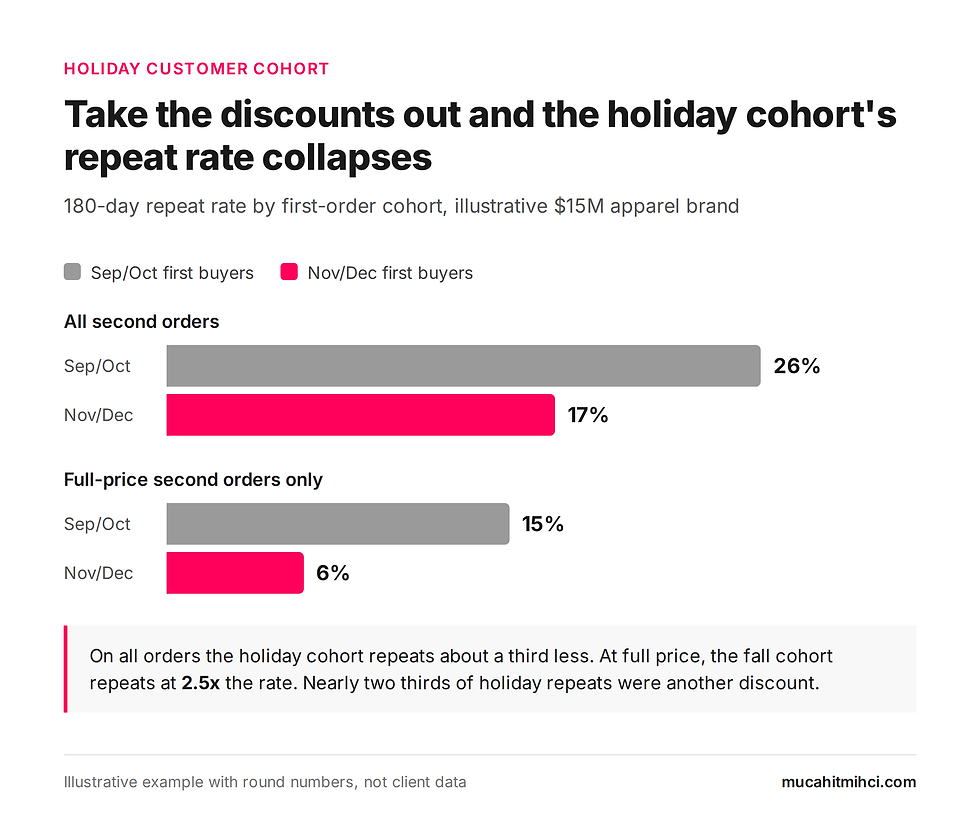
On all second orders, fall first buyers repeat at 26% and holiday first buyers at 17%, about a third less. Count full-price second orders only and it's 15% against 6%. That's two and a half times the rate. Nearly two thirds of the holiday cohort's repeat behavior is another discount, and that's the gap your forecast is missing. It's also the one that decides margin.
The first 60 days decide the curve
The holiday cohort's behavior isn't fixed at checkout. In my experience it bends inside the first 60 days after the order, and three default decisions bend it the wrong way.
The post-purchase flow. Holiday buyers usually get what everyone gets: a thank-you, a review request, then the promotional calendar. A buyer who's never heard of you needs an introduction. How the product is made, how to care for it, what people usually pair with it. If you capture gift recipients at checkout, they deserve their own sequence, though most Shopify checkouts need a change before that's possible.
The path to the second order. If the next thing a holiday buyer sees is another sale, you've confirmed the anchor they came in with. A full-price second-order path offers a product that complements what they bought, with no code attached. Fewer will take it. The ones who do have just paid your real price, which changes what kind of customer they are.
The promo calendar. Most brands drop holiday buyers straight into January clearance sends because they're on the list and the list gets everything. That's the fastest way to teach a borrowed customer to wait.
Holding them out of sitewide promos for their first 45 to 60 days will cost visible January revenue, and the payoff lands months later where nobody connects it back. So don't roll it out on faith. Split the holiday cohort, hold half out, keep half on the normal calendar, and read full-price repurchase at 90 days. It's a test you can reverse in a week, and it produces a number finance will accept.
Give the holiday cohort its own CAC payback line
Black Friday CAC almost always looks good. Intent is high, conversion is high, and cost per new customer lands under the yearly average. Blended into the annual number, it makes acquisition look efficient.
But payback on a first order discounted to win the sale depends on the second order. If the holiday cohort takes twice as long to reach it, or never does, the payback on that weekend's spend is a different number from the one in the plan.
The size of the error is easy to estimate. Using the illustrative brand above: about 100,000 new customers a year, 30,000 of them in November and December. If the plan applies the fall cohort's 26% repeat rate to the holiday cohort and the real figure is 17%, that's about 2,700 second orders that aren't coming. At an $85 AOV, roughly $230,000 of first-half repeat revenue that was never real, before counting third orders.

So holiday cohorts get their own line. Their own CAC, their own full-price repurchase curve, their own payback period, forecast on their own history. This holds whatever your gap turns out to be. If it's 2 points, the separate line confirms Black Friday is buying real customers. If it's 15, it stops next year's plan from being built on them. Blending hides the answer in both cases.
None of this is an argument for cutting Black Friday spend. Pulling budget mid-Q4 is hard to undo and the acquisition itself isn't the problem. Change what happens after the order, and change how you count it.
If you're reading this after the holidays
The holiday buyers are already in your file and probably already on the January promo schedule. Three things still work.
Tag the holiday cohort now, so it can be reported separately from here on. Pull it out of the next sitewide send and give it a full-price product recommendation instead. And rebuild the first-half repeat revenue forecast with the holiday cohort on its own line before the Q1 review, not after.
Plan January before you write the Black Friday email
Black Friday customer retention gets decided in the planning doc, long before the sale. Most brands plan Q4 in this order: offer, creative, send schedule, and somewhere in late December, a question about what happens to all these new people. By then the January calendar is full of clearance.
Flip it. Before the first Black Friday email is drafted, decide what a holiday buyer receives in their first 60 days, what their full-price second-order path looks like, and who owns the holiday cohort's 180-day number.
Monday morning diagnostic
Two pulls, both from data you already have.
One. Take last year's November and December first-time buyers and calculate 180-day repeat rate twice: all second orders, then full-price second orders only. If the full-price number is a fraction of the all-orders number, most of that cohort's repeat revenue depends on the next discount.
Two. Pull the sends holiday buyers received in their first 60 days. If most were promotional, you've been training your newest customers to wait during the window when their behavior was still open.
If you can't separate full-price from discounted second orders, that's the finding. You've been forecasting repeat revenue without knowing how much of it needs a sale to happen.
If the gap turns out bigger than you expected, that's the conversation I have most with brands around Q4.

FAQ
Do Black Friday customers have lower retention than other new customers?
Usually yes, and the gap is larger than it first appears. Comparing holiday cohorts to fall cohorts on all repeat orders understates it, because fall cohorts' repeat windows include Black Friday itself. Counting only full-price second orders, or comparing against the previous year's holiday cohort, gives a cleaner read. Holiday first buyers are more often acquired through paid ads, anchor on the year's deepest discount, and a share are buying gifts for someone who never interacts with the brand.
How do you retain customers acquired during Black Friday and Cyber Monday?
Retaining holiday shoppers comes down to the first 60 days after the order. Give holiday buyers a post-purchase sequence that introduces the brand, offer a full-price second-order path instead of another discount, and test holding them out of sitewide January promotions for 45 to 60 days using a split cohort so the effect can be measured.
Should holiday customers be included in repeat revenue forecasts?
Yes, as a separate cohort with its own full-price repurchase curve and CAC payback period. Blending them into the annual average assigns them the repeat behavior of customers acquired in the rest of the year, which overstates next year's repeat revenue and makes holiday acquisition look more efficient than it is.


Comments