

Slow Advertising: What Fashion's Biggest Marketing Shift Means for Ecommerce Retention

Updated: Sep 11
What Is Slow Advertising, And Why Should Ecommerce Care?
WGSN's head of consumer forecasting Cassandra Napoli called 2025 the "year of great exhaustion." The Business of Fashion picked it up as one of the five defining themes for fashion marketing in 2026. The concept has a name now: slow advertising.
You'll also see it called slow marketing or slow commerce. Same shift, different label.
But what does it actually mean?
Here's the short version. After years of flooding every channel with content (AI-generated campaigns, endless influencer collaborations, controversy-baiting ads, and always-on social), fashion brands are hitting a wall. Not because the content stopped performing on paper. But because consumers stopped caring.
The numbers tell the story:
Two-thirds of consumers now express "trend fatigue" and are actively ignoring trends, according to Stitch Fix's 2026 data across 2+ million customers
70% of consumers unsubscribed from at least three brands in the past three months due to excessive messaging (Optimove's 2025 Marketing Fatigue Report)
81% of consumers open emails only when they're tailored to their interests. Generic blasts get ignored
Luxury brands chasing constant visibility through celebrity tie-ups created what BoF calls "an epidemic of sameness": ubiquity and fatigue instead of aspiration
How did we get here? It's the end result of a very specific chain reaction:
iOS 14.5 gutted ad attribution in 2021
Brands panicked and over-indexed on owned channels (email, SMS) to compensate
Shein and Temu's rise created pricing pressure that pushed brands into constant promotional messaging
AI tools made content creation nearly free, so brands produced more of everything
Consumer inboxes, feeds, and phones got flooded from every direction
Trust eroded, engagement declined, and fatigue became the default state
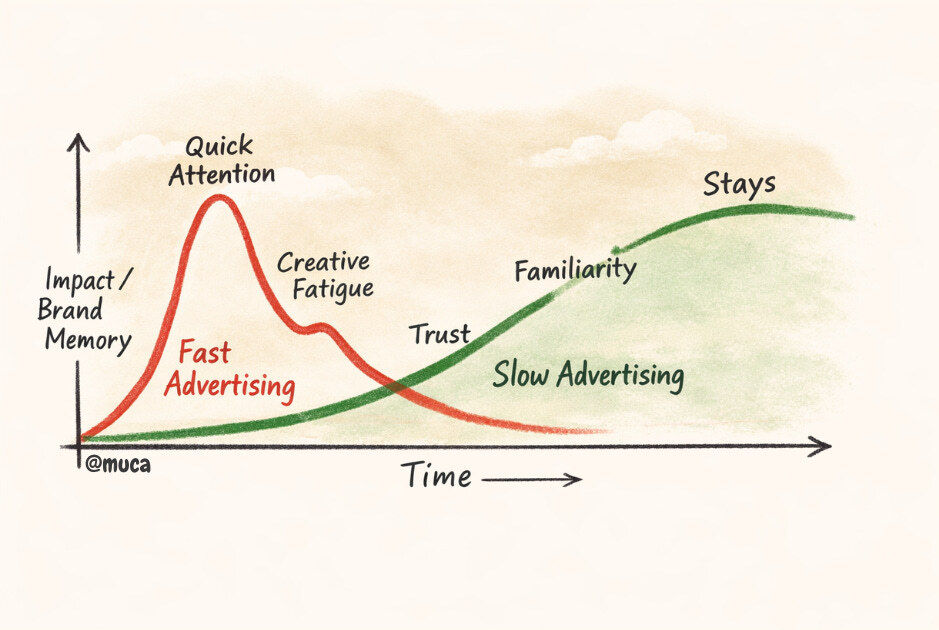
Slow advertising is the correction. BoF describes it as marketing that is "less about grabbing attention at any cost and more about earning it." In practice, that means:
Fewer touchpoints, more emotional clarity
Human connection over AI novelty
Brand storytelling rooted in self-awareness, not virality
Pantone even picked up the signal. Their 2026 Color of the Year is Cloud Dancer, a shade of white that, as Fast Company put it, "telegraphs a desire for blankness at a time when the overstimulation of the internet is only increasing."
The entire culture is asking for less noise.
But here's why this matters for ecommerce, not just brand teams:
Slow advertising isn't a creative direction. It's a structural problem with a lifecycle solution. And if you're running CRM, email, or retention for an apparel brand, this shift is either an opportunity you capture or a gap that accelerates your churn.
The Problem Underneath: Consumer Fatigue Is a Retention Killer
Let's be honest about what "consumer exhaustion" actually looks like inside an ecommerce apparel brand's data.
You've seen it. You may not have called it slow advertising. But you've seen the symptoms:
Open rates declining despite list growth. Your email list is bigger than ever, but engagement per subscriber is dropping. You're reaching more people and connecting with fewer.
Unsubscribe rates creeping up. Not dramatic. Just a slow bleed. 0.3% becomes 0.5% becomes 0.8%. Each month, you lose a little more of the audience you paid to acquire.
Click-to-purchase ratios flattening. People open, they click, they browse, and then they leave. The intent is there. The conversion isn't. Something between the click and the checkout is eroding trust.
Win-back flows underperforming. Your lapsed customer segments keep growing. The "We miss you" emails get weaker returns every quarter. Discounts that used to work now get ignored.
Campaign revenue looks healthy, but repeat purchase rate is flat. The dashboard says email drives 30% of revenue. But when you dig into cohorts, first-to-second purchase conversion hasn't moved in 12 months. The revenue is coming from the same loyal customers buying more, not from new customers being retained.
This is what consumer fatigue looks like on the retention side. It's not a branding problem. It's a lifecycle problem. Your customers aren't disengaging from your product. They're disengaging from your communication pattern.
And the standard playbook makes it worse:
Engagement drops, so brands send more emails, engagement drops further, add SMS, add push, customer unsubscribes, brand blames "the algorithm."
That's the cycle slow advertising is trying to break at the brand level. But lifecycle marketers can break it at the system level, faster and more precisely.
The Cost of Fatigue: A Number Your CFO Will Care About
Consumer fatigue feels abstract until you put a dollar sign on it. So let's do the math.
Say your ecommerce apparel brand has a 200,000 subscriber email list. Your unsubscribe rate has crept from 0.3% to 0.6% over the past year. That looks small, but it means you're losing an additional 600 subscribers per month that you weren't losing before.
If your average CAC is $60 (the fashion ecommerce B2C average sits around $60-70), those 600 people represent $36,000/month in acquisition investment walking out the door. That's $432,000 per year. Not because they didn't like your product, but because your communication pattern exhausted them.
Now add the hidden costs:
Deliverability decay. Every unsubscribe and spam complaint hurts your sender reputation. Lower deliverability means your remaining subscribers see fewer of your emails. The fatigue problem compounds silently: your list gets smaller AND less reachable at the same time.
Engagement drag. Disengaged subscribers who don't unsubscribe but stop opening pull down your overall engagement metrics. Email providers like Gmail use engagement signals to decide inbox vs. promotions tab placement. Fatigue doesn't just lose customers. It makes you less visible to the ones who stayed.
Win-back inflation. Every customer who lapses due to fatigue enters your win-back flows, which cost money to run and convert at declining rates. You're spending to win back customers you pushed away.
The bottom line: For a mid-size ecommerce apparel brand ($5-15M revenue), the total cost of unchecked communication fatigue, including lost subscribers, deliverability impact, and win-back waste, is conservatively $500K-$1M annually. Not from bad products. Not from weak branding. From sending too much, to too many, too often.
That's not a marketing problem. That's a P&L line item. And it's the number that turns "slow advertising" from a creative philosophy into a business case.
Why Lifecycle Marketers Already Know This Playbook
Here's the thing that most coverage of slow advertising misses: this isn't new thinking. It's brand teams discovering what CRM and lifecycle teams have practiced for years.
The core principles of slow advertising:
Earn attention, don't grab it
Fewer, more intentional touchpoints
Emotionally grounded messaging
Deep customer understanding over broad reach
Measure trust and retention, not just impressions
Now translate those into lifecycle language:
Earn attention = Send based on behavior and stage, not calendar
Fewer touchpoints = Frequency capping, smart suppression, flow-based logic instead of campaign blasts
Emotionally grounded = Messaging that reflects where the customer actually is (just bought? browsing? lapsing?), not where your marketing calendar says they should be
Deep understanding = Segmentation by lifecycle stage, purchase history, engagement decay, not just demographics
Measure trust = Repeat purchase rate, LTV by cohort, time-to-second-purchase. Not open rates.
Slow advertising is lifecycle segmentation applied to brand.
The difference is that lifecycle marketers do this at the CRM level: individual flows, targeted segments, behavioral triggers. Slow advertising is asking the entire marketing function to operate this way, from paid media to social to content to events.
And that's where the opportunity sits for ecommerce apparel brands. The teams who already think in lifecycle terms (CRM, email, retention) are the ones who should be leading this shift. Not following it.
What Goes Wrong When Brands "Go Slow" Without Lifecycle Infrastructure
Some brands will hear "slow advertising" and do the obvious: cut campaign frequency, reduce ad spend, pull back on social content. That's the surface-level interpretation, and it's dangerous.
Slowing down without a system is just doing less. And doing less, without doing better, doesn't fix fatigue. It creates silence. Silence creates forgetting. Forgetting creates churn.
Here's what happens in practice:
Scenario 1: Brand goes quiet, lifecycle stays the same. The brand team reduces campaign frequency. But the lifecycle/CRM team is still running the same flows (welcome series, abandoned cart, post-purchase, win-back) at the same cadence. The customer's total touchpoint volume barely changes. Nothing improves.
Scenario 2: Everyone reduces frequency, no one improves relevance. Brand sends fewer ads. CRM sends fewer emails. But the content hasn't changed. The customer still gets generic "new arrivals" emails and "you left something behind" carts. The messages are less frequent but equally irrelevant. Engagement continues to decline, just more slowly.
Scenario 3: Slow brand, aggressive retention. The brand team creates beautiful, intentional, slow content. The customer feels respected. Then they get three SMS messages in a week from the retention team pushing a flash sale. The trust the brand built evaporates in one touchpoint.
The common thread: Slow advertising fails when brand and lifecycle don't share the same customer timeline, the same suppression logic, and the same definition of "intentional."
This isn't a creative problem. It's a coordination problem. And coordination requires infrastructure.
The Slow Advertising Lifecycle Framework: How to Actually Do This
If slow advertising is the philosophy, lifecycle infrastructure is the execution layer. Here's how to translate the concept into an ecommerce apparel retention system.
Layer 1: Unified Touchpoint Mapping
Before you change any messaging, map every touchpoint a customer receives in their first 90 days. Every email, SMS, push notification, retargeting ad, and social impression. Most brands have never done this exercise. When they do, they're shocked.
A typical ecommerce apparel customer might receive:
Welcome flow: 4-6 emails in 7 days
Abandoned cart: 2-3 emails + 1-2 SMS
Post-purchase: 3-4 emails in 14 days
Brand campaigns: 2-3 per week
Retargeting ads: continuous
SMS promotions: 1-2 per week
That's potentially 30-40+ brand touchpoints in the first month alone. No wonder consumers are exhausted.
Action: Build a touchpoint calendar that shows EVERY message a customer in each lifecycle stage receives, across all channels, from all teams. This single document becomes the foundation for everything else.
Layer 2: Stage-Based Frequency Capping
Not every lifecycle stage needs the same communication intensity. Here's the framework:
New customer (Day 0-14):
Higher frequency is acceptable IF every message adds value
Welcome, shipping, delivery, check-in are fine
Suppress from ALL brand campaigns and promotional sends during this window
Protect the onboarding experience
Active customer (Day 14-90):
Moderate frequency. One lifecycle touchpoint per week maximum
Brand campaigns allowed but suppressed if a lifecycle flow is active
No channel stacking: if you send an email, don't send an SMS the same day
Repeat buyer (Day 90+, 2+ purchases):
Low frequency. These customers don't need convincing, they need to not be annoyed
VIP early access, exclusive content, loyalty moments only
No generic blasts. Ever.
At-risk / lapsing (no purchase in 60-120 days):
One intentional re-engagement sequence. Not a drip
A single, emotionally grounded message that leads with value: styling content, a product they'd actually want, or a story that reconnects them to the brand
If it doesn't work, wait 30 days before trying again. Resist the urge to chase.
Lapsed (120+ days):
One final attempt. Then let them go, or offer a resale/trade-in prompt as a different kind of re-engagement
Continuing to email lapsed customers damages deliverability and reinforces fatigue for your entire list
Layer 3: Message Quality Over Message Quantity
Slow advertising says: earn attention. In lifecycle terms, that means every message needs a reason to exist beyond "it's Tuesday and we have a campaign scheduled."
The test: Before any email, SMS, or campaign goes out, ask: "If this customer received only this one message from us this week, would it be worth their time?"
If the answer is no, don't send it. The send you skip today protects the open you need tomorrow.
Practical shifts:
Replace "New Arrivals" blasts with curated, segment-specific recommendations based on purchase history and browse behavior
Replace "Sale!" emails with value-first content (styling guides, care tips, behind-the-brand stories) where the product is embedded, not screamed
Replace generic abandoned cart sequences with personalized ones that address the likely hesitation (price? fit? trust?) based on product category and customer stage
Replace "We miss you" win-backs with something the customer actually wants: a fit quiz result, a restocked notification for something they viewed, or a genuine "here's what's changed since you last visited"
Layer 4: Brand + CRM Sync Protocol
This is the hardest layer because it's organizational, not technical. But without it, the other three layers fall apart.
What needs to happen:
Shared suppression lists. If a customer is in an active lifecycle flow (welcome, post-purchase, win-back), they are suppressed from brand campaign sends. Non-negotiable.
Weekly sync. Brand and CRM teams review the upcoming week's touchpoint calendar together. They identify overlaps, conflicts, and gaps. They agree on which customers hear what, and when.
Single lifecycle owner. One person (whether you call them Head of Lifecycle, Customer Journey Manager, or Retention Lead) owns the customer timeline across both brand and CRM. They have the authority to say "we're not sending that this week" to either team.
Shared metrics. Both teams are measured on customer-level outcomes: repeat purchase rate, LTV by cohort, engagement-to-revenue ratio. Not team-level vanity metrics. When brand and CRM share goals, coordination happens naturally.
If You Lead a Team: 5 Action Items This Month
You don't need to overhaul everything at once. Start here:
1. Run the Touchpoint Audit
Map every message a new customer receives in their first 30 days. Every channel, every team. Put it in one document. Share it with leadership. The reaction alone will create urgency.
Timeline: 1 week
Owner: CRM/Lifecycle lead
Output: A single-page touchpoint map showing total message volume by lifecycle stage
2. Implement Post-Purchase Suppression
Starting this week: any customer who made a purchase in the last 14 days is suppressed from all promotional campaigns and brand blasts. They only receive lifecycle flow messages (shipping, delivery, check-in, onboarding content).
Timeline: Immediate (Klaviyo/Braze rule takes 30 minutes to set up)
Owner: CRM/Lifecycle lead
Expected impact: Lower unsubscribe rate, higher post-purchase engagement, stronger second-purchase conversion
3. Kill One Flow
Look at your active flows. Find the one with the lowest engagement-to-conversion ratio. Turn it off. Replace it with nothing, for now. Observe what happens. In most cases, removing a low-performing flow improves overall engagement because you're reducing noise without losing meaningful revenue.
Timeline: This week
Owner: CRM/Lifecycle lead
Expected impact: Improved deliverability, slight lift in engagement across remaining flows
4. Propose a Weekly Brand-CRM Sync
Send your brand/marketing counterpart a simple message: "Can we do a 15-minute weekly check-in to make sure our customer touchpoints aren't conflicting?" Start small. Share the touchpoint audit as a conversation starter. You don't need executive buy-in to start coordinating.
Timeline: Schedule this week, start next week
Owner: CRM/Lifecycle lead + Brand/Marketing lead
Expected impact: Fewer conflicting messages, first step toward unified customer timeline
5. Change One Metric
If your team currently reports on open rate and campaign revenue, add one metric: second purchase rate within 90 days, by acquisition cohort. This single metric tells you whether your lifecycle system is working. If it's flat or declining while campaign revenue looks healthy, you know you have a fatigue problem, and a retention system that isn't converting new customers into repeat buyers.
Timeline: Next reporting cycle
Owner: CRM/Lifecycle lead + Analytics
Expected impact: Shifts the conversation from "how much did email make?" to "are we actually retaining customers?"
What Success Looks Like in 90 Days
If you implement these five steps and commit to the framework above, here's what you should realistically see after 90 days. Not promises, benchmarks based on what these types of changes typically produce in ecommerce apparel.
Month 1 (Weeks 1-4): The Audit and Quick Wins
You've completed the touchpoint audit. Your team is slightly uncomfortable: the total message count per customer was higher than anyone expected. Post-purchase suppression is live. You've killed one underperforming flow. Total send volume is down 15-25%, but revenue impact is negligible because the sends you cut weren't converting anyway.
Early signals:
Unsubscribe rate starts to flatten or tick down slightly
Post-purchase email engagement (open + click) lifts 10-20% because those customers are no longer buried in promotional noise
Your first Brand-CRM sync happens. Awkward at first, productive by week 3
Month 2 (Weeks 5-8): The System Takes Shape
Stage-based frequency capping is in place. Your highest-value segments (repeat buyers, VIP) are finally protected from generic blasts. Message quality improves because your team is forced to make fewer sends count more.
Mid-stage signals:
Overall list engagement rate (unique openers / total list) improves 5-15%
Spam complaint rate drops. This is the deliverability dividend: less noise = fewer complaints = better inbox placement
Your team starts asking "should we send this?" instead of "what else can we send?" This is the cultural shift. When this question becomes normal, you've won.
Month 3 (Weeks 9-12): The Retention Signal
This is where the real metric moves. It takes 60-90 days for lifecycle changes to show up in repeat purchase data because you're measuring behavior over time, not immediate reactions.
What to look for:
Second purchase rate within 90 days starts to move. Even a 2-3 percentage point lift is meaningful at scale. On 5,000 new customers/month with a $100 AOV (the North American fashion ecommerce average), a 3-point lift in second purchase rate = $180,000 in additional retained revenue annually
LTV by cohort for the "post-change" cohort (customers acquired after you implemented these changes) should begin to diverge positively from pre-change cohorts
Win-back flow performance improves because fewer customers are lapsing due to fatigue in the first place, and the ones who do lapse respond better to fewer, more intentional messages
What success does NOT look like:
Total email revenue may appear flat or even dip slightly in Month 1. This is normal. You're sending less. The instinct will be to panic and revert. Don't. Watch the cohort-level metrics, not the aggregate dashboard. If second purchase rate and LTV are moving in the right direction, you're building a healthier, more sustainable revenue base, even if the top-line number takes a quarter to catch up.
The CFO version: You're trading $432K/year in fatigue-driven subscriber loss for a system that compounds. Every month the system runs, it retains more, wastes less, and makes each acquisition dollar more productive. By Month 6, the gap between your old approach and the new one becomes impossible to ignore.
The Bottom Line
Slow advertising isn't about doing less marketing. It's about doing marketing that respects the customer's attention and earns their trust over time.
For brand teams, that means fewer campaigns, more intentionality, and better storytelling.
For lifecycle teams, it means something more specific: build the infrastructure that makes "slow" sustainable.
Touchpoint mapping
Stage-based frequency
Suppression logic
Brand-CRM coordination
Quality gates on every send
The brands that win in 2026 won't be the loudest. They'll be the ones whose customers actually want to hear from them.
That's not a brand strategy. That's a lifecycle system.
Lifecycle Systems is where I break down the operational decisions behind retention, CRM, and customer lifecycle strategy in ecommerce. Not opinions, frameworks. Subscribe if that's what you're building.
Frequently Asked Questions
What is slow advertising?
Slow advertising is a 2026 marketing concept coined by WGSN's Cassandra Napoli in response to what she calls the "year of great exhaustion." It describes a shift from high-volume, attention-grabbing campaigns to fewer, more intentional, and emotionally grounded brand communications. Instead of chasing virality and constant visibility, slow advertising focuses on earning consumer trust through relevance, human connection, and clarity of brand identity.
Why are consumers experiencing marketing fatigue in fashion?
Consumer fatigue in fashion stems from oversaturation across every channel. According to Optimove's 2025 Marketing Fatigue Report, 70% of consumers unsubscribed from brands in the past three months due to excessive messaging. Stitch Fix reports that two-thirds of their 2+ million customers express trend fatigue and are actively ignoring trends.
The combination of accelerated trend cycles, AI-generated content overload, endless influencer collaborations, and always-on social media has pushed consumers from engagement to exhaustion.
How does slow advertising connect to lifecycle marketing?
Slow advertising and lifecycle marketing share the same core principles: communicating based on customer context rather than marketing calendar, prioritizing relevance over volume, and measuring success through trust and retention rather than impressions and reach. The difference is scope.
Lifecycle marketers apply these principles at the CRM level through behavioral triggers and stage-based flows, while slow advertising asks the entire marketing function to operate this way.
What is the first thing an ecommerce brand should do to implement slow advertising principles?
Run a touchpoint audit. Map every message a new customer receives across all channels (email, SMS, push, retargeting, social) in their first 30 days. Most brands discover they're sending 30-40+ touchpoints in that window.
This single exercise creates the visibility needed to identify where fatigue is happening and where to reduce or replace messages with more intentional communication.
How do you measure whether slow advertising is working?
Track second purchase rate within 90 days by acquisition cohort. This metric tells you whether your communication strategy is converting new customers into repeat buyers.
If campaign revenue looks healthy but second purchase rate is flat or declining, you have a fatigue problem: your system is extracting value from loyal customers while failing to retain new ones.
What is the actual cost of marketing fatigue for an ecommerce brand?
For a mid-size ecommerce apparel brand ($5-15M revenue) with a 200K subscriber list, the total cost of unchecked communication fatigue (including lost subscribers, deliverability decay, and win-back waste) conservatively runs $500K-$1M annually.
A 0.3% increase in unsubscribe rate on a 200K list means losing 600 additional subscribers per month. At a $60 CAC (the fashion ecommerce B2C average), that's $432K/year in acquisition investment walking away, before accounting for the compounding effects on deliverability and engagement across the rest of your list.


Comments