

Klaviyo's AI Agent Learns. Your Lifecycle Strategy Doesn't.

Klaviyo shipped something worth paying attention to last month.
Their new AI agent doesn't just send messages. It listens. A customer mentions they're shopping for a gift, returning a size, or looking for something specific, and the agent writes that signal back to the profile. The next interaction starts with that context already loaded. No setup. No manual tagging. No waiting for someone to build a segment.
I've watched brands spend two years and significant budget trying to do exactly that, manually. The fact that it now happens automatically in conversation is not a small thing.
But here's where I want to slow down, because the reaction I'm seeing is worth examining.
Most of the response to this launch has been about the capability. What the agent can do. How it learns. What it captures. That's the right conversation for practitioners. Wrong conversation for a CMO reviewing retention numbers at the end of Q2.
The question that matters for that person isn't can the agent capture this signal? It's what does my lifecycle program do with it once it does?
I call the gap between those two questions signal activation lag. And it's been the quiet killer in retention programs long before AI agents existed.
The problem that predates the tool
Think about the personalization gap I've written about before. Brands weren't failing at personalization because the data didn't exist. It existed in five different systems. Purchase history in the commerce platform. Browse behavior in the analytics layer. Returns data in the operations system. Preference signals from support tickets. Product affinity from loyalty interactions. The data was there. It just never reached the lifecycle platform in a form the platform could act on.
Klaviyo's AI agent closes one version of that gap. Signals captured mid-conversation now write directly to the profile. Real improvement. The profile gets smarter in real time.
What doesn't automatically improve is what happens next.
Most lifecycle programs aren't built to respond to new signals with new behavior. They're built around the average customer, sending the average message, at the average time. I wrote about this as the phantom segment: the statistically constructed customer that no one in your actual database resembles, but your entire automation architecture was built to serve.
When the agent captures that a customer is shopping for a gift, the profile updates. But if the gift-buyer segment doesn't exist in your flow logic, or the gift signal doesn't trigger a different content path, or your team hasn't decided what gift buyer means for repurchase timing, the signal sits in the profile and does nothing. It's captured. It's not activated.
That's not a Klaviyo problem. That's an architecture problem.

What AI agents actually change
To be fair to what Klaviyo shipped: the profile enrichment capability closes the capture gap faster than anything I've seen built manually. Brands that had zero conversational signal data now have a path to real behavioral context. Valuable. It raises the ceiling on what's possible.
But raising the ceiling and changing the floor are different things.
The floor is what your lifecycle program actually does with a customer in the first 60 days. A sequence of decisions that either move that customer toward a second purchase or don't. If this signal appears, the next touchpoint changes. That logic is written by people. It requires someone to decide what signals matter, what thresholds trigger action, and what the action actually is.
What I saw at brands dealing with inventory blindness is relevant here. The lifecycle platform didn't know which products were out of stock at the variant level, so it kept promoting them. Adding AI capabilities to that platform wouldn't have fixed the problem. It would have learned faster and recommended the same unavailable products more confidently.
Better intelligence applied to broken architecture produces better-looking broken outcomes.
The organizational question Klaviyo can't answer
Klaviyo's four updates give the platform a stronger ability to listen, learn, and respond. Forward-deployed agents that self-refine. Multilingual support. Profile enrichment from conversation. Headless APIs for teams that want to build on top.
These are real capabilities, not feature theater. For a brand that has already sorted out activation, this is a real accelerant.
For most brands I've seen, activation hasn't been sorted out. Your lifecycle team is still running on campaign logic written 18 months ago. Flows that touch a new customer in the first 45 days haven't been audited against actual repurchase data. The 60-Day LTV % for cohorts that went through those flows versus cohorts that didn't has never been compared. Nobody on the team owns that question.
That's the accountability gap. And it compounds, because now the team will spend cycles learning the new AI capabilities without first fixing the activation logic the AI will be executing against.
The automation debt I wrote about earlier was this exact dynamic at a smaller scale: brands building more automation on top of automation that wasn't working. Same pattern, one layer up. More intelligence. Same broken architecture underneath.
What the onboarding window actually costs
This is where it gets concrete.
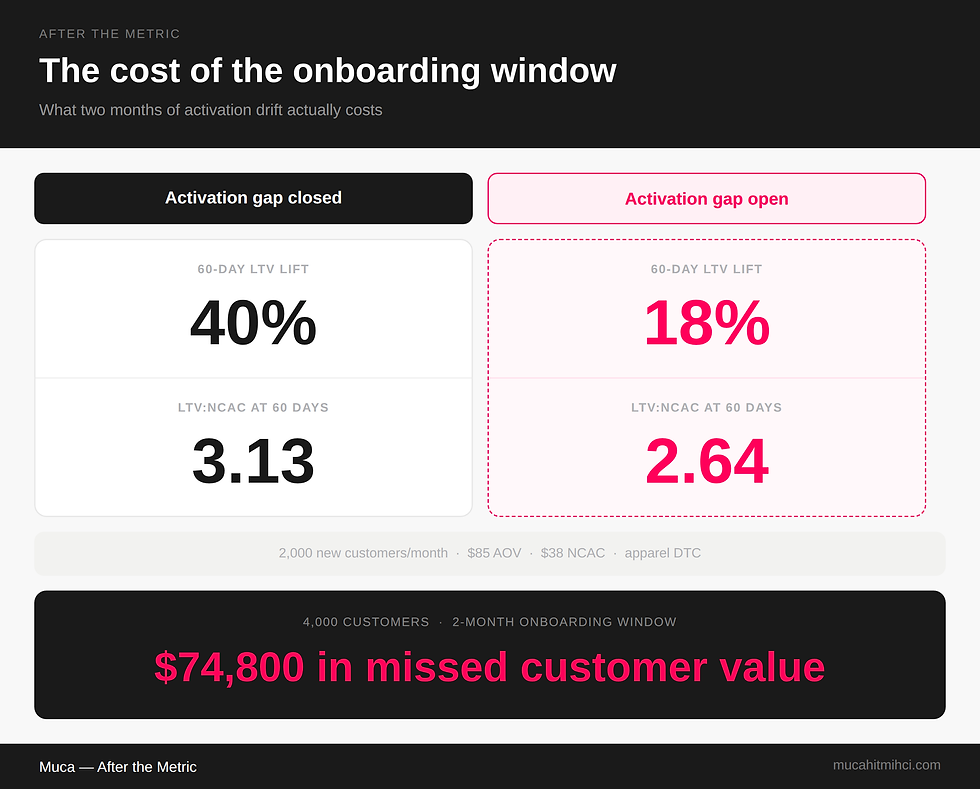
A mid-size apparel brand running 2,000 new customers a month through a lifecycle program with an unresolved activation gap is leaving roughly $18.70 per customer on the table in 60-Day LTV. Roughly the difference between a program that moves customers from first purchase to second with real behavioral context and one that sends the same flow to everyone.
Over a two-month AI agent onboarding window, that's 4,000 customers passing through the same broken activation logic while the team is heads-down on a new capability. Missed customer value from that window: around $74,800. Not because the AI agent didn't work. Because nothing changed about what the program does when a signal arrives.
LTV:NCAC tells the same story. With activation working, an $85 AOV brand with $38 NCAC reaches a 60-day LTV:NCAC of 3.13. With the gap open, it sits at 2.64. That 0.49 difference is what you're presenting to your board as a retention number. And it's a gap your paid team and your new AI vendor both missed because nobody owned activation as a distinct problem.
There's a version of the next 90 days where you onboard the AI agent and fix activation simultaneously. That version requires someone to decide, before the onboarding starts, what the activation architecture needs to look like. That decision belongs to the CMO, not the lifecycle team and not Klaviyo.
What to actually do with this
Before your team spends time on the AI agent setup, answer three questions:
What signals does your lifecycle program currently act on, and how quickly? If the answer takes more than a day to produce, activation is already the problem.
What happened to the first-purchase cohorts from your last three major campaigns in terms of 60-Day LTV %? If those numbers aren't readily available, you don't yet have the measurement infrastructure that makes the AI agent's learning useful.
Who owns the decision about what a captured signal means for the next lifecycle touchpoint? If that answer is it depends or we'd have to discuss it, the AI agent will capture signals into a vacuum.
Your agent gets smarter with every conversation. That's only valuable if your strategy is smart enough to use what it learns.
Monday morning diagnostic
Pull your most recent lifecycle flow that touches new customers in the first 30 days. Count how many distinct behavioral signals it uses to change the path a customer takes. If the number is under three, your activation gap is larger than your capture gap. Your AI agent will make the capture gap disappear. It won't touch the activation gap at all.
FAQ
What is signal activation lag in ecommerce lifecycle marketing?
Signal activation lag is the gap between when a customer signal is captured (a preference, a behavior, a stated intent) and when the lifecycle program changes what it sends that customer based on that signal. Most brands have a significant lag, often because the captured data exists in the profile but the flow logic wasn't built to respond to it.
Does Klaviyo's AI agent fix retention problems automatically?
No. Klaviyo's AI agent improves signal capture by writing conversational context back to the customer profile in real time. What it doesn't change is the activation logic that determines what the lifecycle program does with those signals. Retention improvement requires both: better signals and better decisions about what to do with them.
How should CMOs evaluate AI lifecycle tools against retention metrics?
The right evaluation frame is 60-Day LTV % and repeat purchase rate at the 45-day window, not engagement metrics. An AI tool that improves open rates without improving second-purchase rates isn't moving the retention numbers that matter. Test cohorts that enter the AI-assisted flows against cohorts that don't, and measure the difference in customer value at 60 days, not the difference in click-through.


Comments